
What Actually Makes a Website Fast, and Does It Matter for SEO?
Yes — page speed is a confirmed Google ranking factor through Core Web Vitals, and it directly affects how much of a site search engines can crawl. Speed mostly comes down to image optimization, minimal unnecessary JavaScript, and genuinely efficient hosting — not a single magic setting.
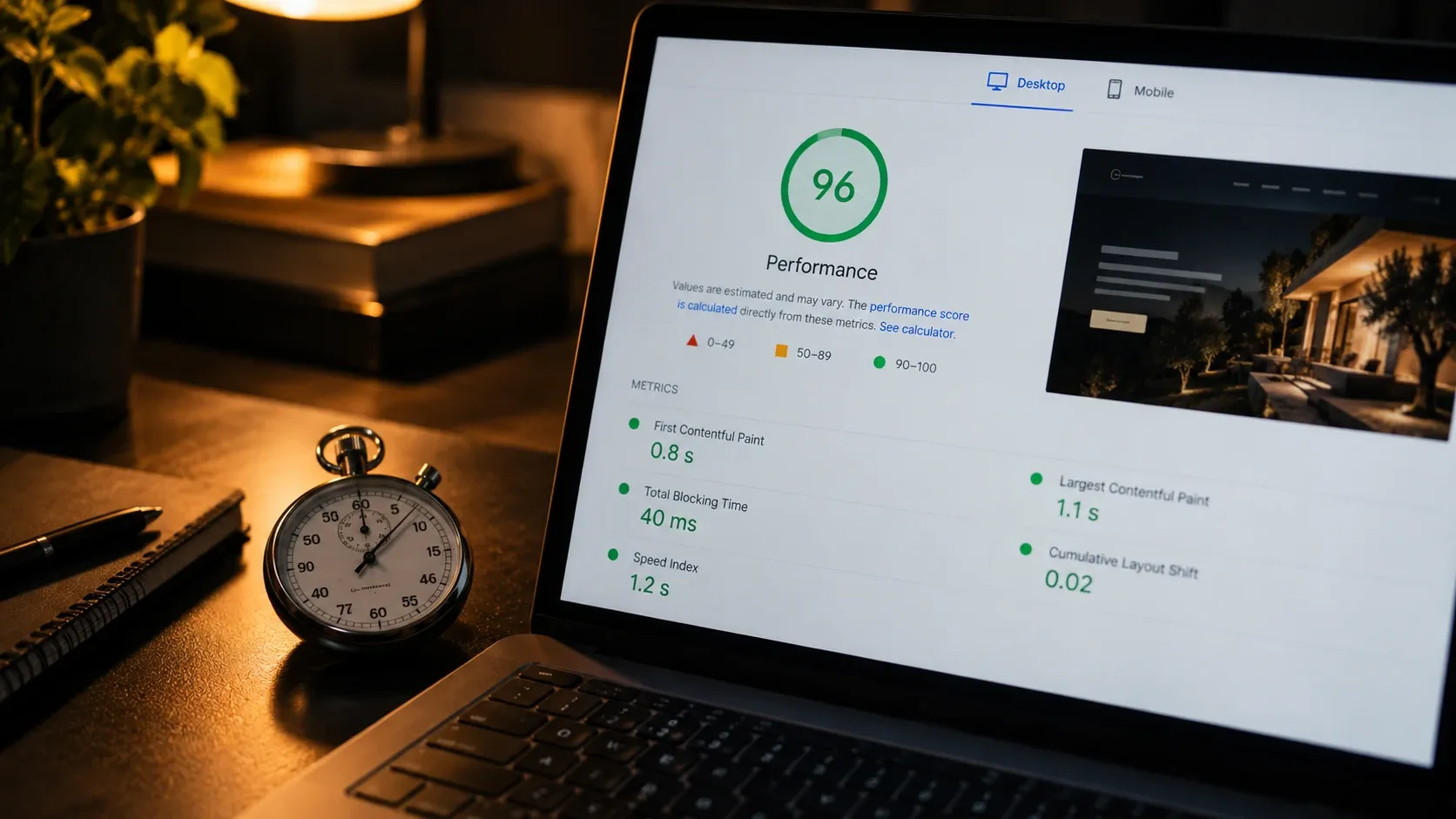
Yes, speed is a real ranking factor
Google's Core Web Vitals — measuring loading performance, interactivity, and visual stability — are a confirmed part of how pages get ranked, not a rumor. Beyond direct ranking impact, a slow site also gets crawled less thoroughly, which limits how much of it search engines index at all.
What actually makes a site slow
Unoptimized images
The single biggest, most common cause. A 5MB photo displayed at 400px wide is pure waste — properly sized and compressed images (modern formats like WebP, sized to their actual display dimensions) fix more speed problems than almost anything else.
Excess JavaScript
Every script a page loads before it can render adds to how long a visitor waits. Sites built with more interactivity than they need — animation libraries, tracking scripts, third-party embeds — pay for it in load time.
Hosting and infrastructure
A site hosted on infrastructure that has to build a fresh page render on every single request, with no caching or a slow database connection, will feel sluggish no matter how optimized the front end is.
What to prioritize
1. Image optimization first — it's the highest-impact, lowest-effort fix on almost every site.
2. Remove or defer anything not needed for the initial render — a script that only matters after a user scrolls doesn't need to block the page from loading.
3. Choose hosting and a framework built for real performance from the start, rather than trying to optimize around a fundamentally slow foundation later.
The bigger picture
Speed isn't a one-time fix — it's a constraint that has to be respected every time something new gets added to a site. A fast launch that slowly accumulates unoptimized images and scripts over a year ends up back where it started.
Questions people ask
What's a good Core Web Vitals score to aim for?
Google publishes specific thresholds per metric (loading, interactivity, visual stability), but as a practical target: scoring in the 'Good' band across all three in Google's own PageSpeed Insights tool is the realistic goal, not a perfect 100.
Does a fast site guarantee good rankings on its own?
No — speed is one factor among many, not a silver bullet. A fast site with thin or irrelevant content still won't outrank a slightly slower site with genuinely better, more relevant content. Speed removes a ceiling; it doesn't replace the content work.
Newsletter
Liked this? Get the next one first
New writing on getting found in search and AI answers, restaurant marketing, and the work behind our projects. Only when it’s worth your time.
How we can help
Custom Next.js and Payload websites, paired with original in-house photography and video — built to load fast, rank well, and give you full editorial control without touching code.
SEOTechnical SEO, on-page structure, and local search optimization for Tampa-area businesses — the foundation that makes every other marketing channel perform better.
Proof
Keep reading
There is no single right platform. Squarespace and Wix are genuinely good choices for a small site that rarely changes. WordPress suits content-heavy sites with a maintainer. A custom build earns its cost when the site is a working part of the business rather than a brochure, and when speed, structure or integrations start deciding revenue.
When Should a Business Redesign Its Website?Redesign when the site is costing you something measurable, not when it feels dated. The real signals are slow loading, poor mobile experience, visitors who arrive and do not convert, a brand that no longer matches, content nobody can update, and a business that has changed while the site has not. Looking old is the least important reason on that list.
Why a Beautiful Website Still Doesn't Generate LeadsDesign and conversion are different jobs. A site can be genuinely beautiful and still generate nothing, because leads depend on getting the right traffic, matching what those visitors came to do, saying something specific, asking clearly, being trustworthy, loading fast and working on a phone. Design supports all of that and replaces none of it.