
How to Increase Restaurant Profit Without Getting More Customers
You can raise restaurant profit without adding a single guest by making more money from the sales you already have. The levers are recipe costing, portion control, vendor pricing, menu engineering, forecast-based scheduling, waste tracking and comp control. On thin margins, a few points of improvement in food and labor efficiency often moves the bottom line more than a marketing push.
Can you increase restaurant profit without more customers?
Yes. On a thin margin, improving what you keep from existing sales is often faster and cheaper than buying new sales. The levers are recipe costing, portion control, vendor pricing, menu engineering, scheduling to forecast, waste tracking and comp control. None of them require a marketing budget, and most can be started this week.
When profit is down, the instinct is to sell more. Run an ad. Post more. Add a promotion. Sometimes that is right. But there is a second question worth asking first: of the money already coming in, how much are we keeping, and why is it not more?
Why this usually beats a marketing push
Consider two ways to add ten thousand dollars of annual profit to a restaurant.
The first way is to sell more. If the business currently keeps about five cents of every dollar, ten thousand dollars of extra profit requires roughly two hundred thousand dollars of additional sales. That is a serious amount of new volume, and generating it costs money in ads, discounts and extra labor, which pushes the target higher still.
The second way is to keep more of what already comes in. A restaurant doing seven hundred thousand a year only needs to improve its margin by about a point and a half to reach the same ten thousand dollars.
A point and a half is a portion spec, a vendor conversation and a schedule change. Two hundred thousand in new sales is a campaign, a year and a lot of luck.
Both paths are legitimate. The second one is almost always the one nobody has tried.
Start with what a dish actually costs
Most independent restaurants price their menu once, at opening, and then adjust by feel. Meanwhile every ingredient in the building has changed price at least once.
Recipe costing fixes that. You write down every component of a dish, including the things people forget, and you price them at what you pay today.
The forgotten items are where it gets interesting:
Oil for the fryer. Butter for the pan. The garnish. The sauce cup. The container, lid and bag for takeout. The napkin and cutlery kit. Bread that goes out free. The dressing that is never on the recipe card.
None of that is expensive on its own. Add it to a dish you sell four hundred times a month and it stops being a rounding error.
Do this for your top ten sellers first. Those ten items usually carry most of your volume, so that is where an hour of costing work pays best.
Portion control is the most direct lever you have
A portion spec is only real if it is measured. Otherwise it is a suggestion, and every cook interprets it differently.
Watch what happens with one ounce. Suppose a dish specs six ounces of protein at eight dollars a pound. That protein costs three dollars. If it goes out at seven ounces instead, it costs three dollars and fifty cents. Fifty cents.
Sell that dish three hundred times a month and the overage is a hundred and fifty dollars. Over a year it is eighteen hundred dollars, from one item, from one ounce, on a plate that looked completely normal every single time it left the pass.
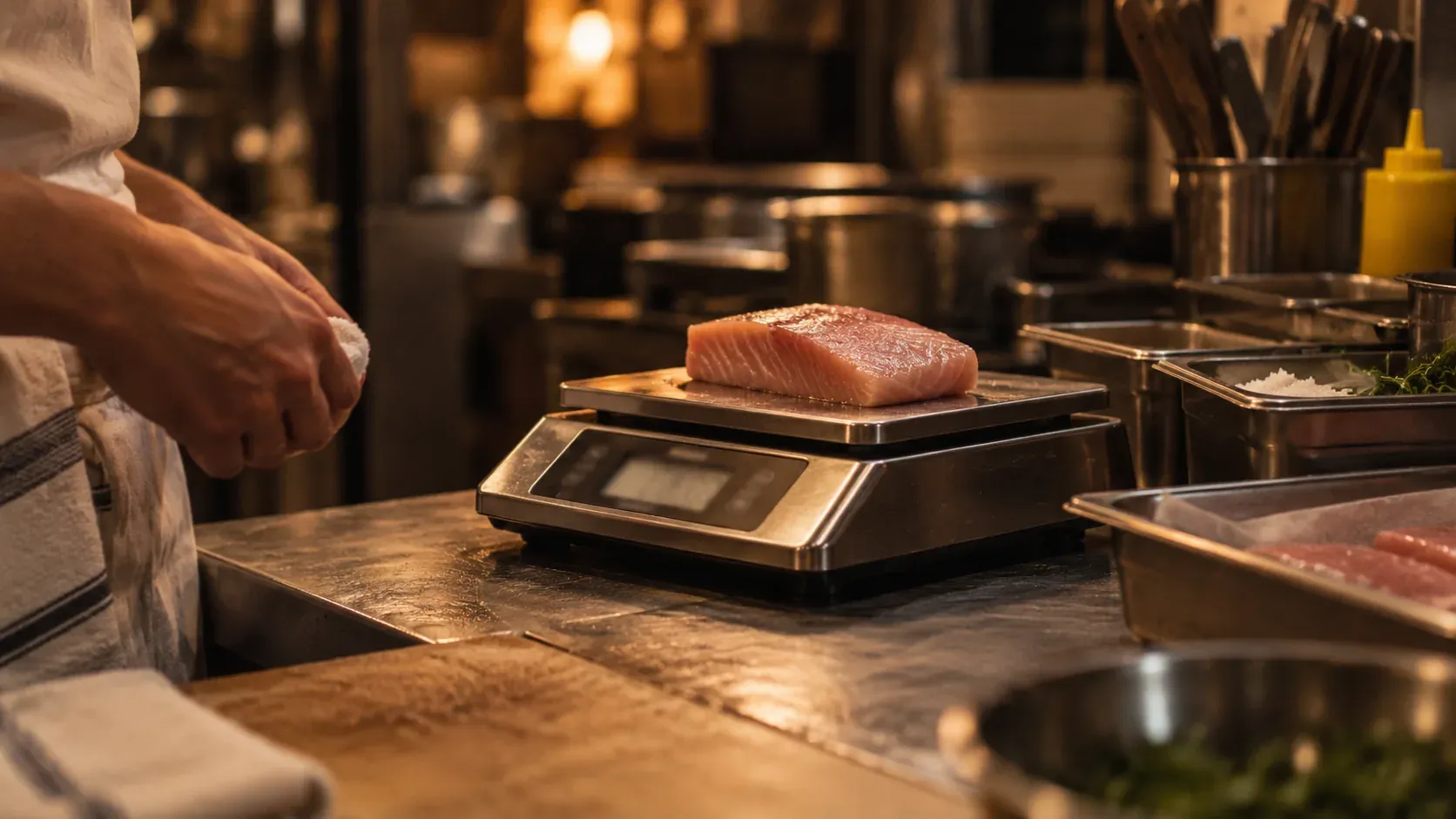
Now apply the same drift to sauces, cheese, fries and pours. The fix is not complicated. Scales on the line, specs posted at the station, and a manager who spot checks. What makes it hard is consistency, not difficulty.
Ask your vendors the question nobody asks
Vendor prices move, and they rarely move down on their own. Very few operators audit them.
Three things worth doing this quarter:
Pull twelve months of invoices for your top ten items and chart the price. You are looking for the increases that arrived without a conversation.
Ask for a competitive quote on your five largest line items. You do not have to switch suppliers. Having the quote changes the conversation.
Check your case sizes and pack counts. A price that held steady while the pack shrank is a price increase wearing a disguise.
Fix the menu instead of just raising prices
Raising every price by a dollar is the blunt version of this. Menu engineering is the precise one.
For each item, work out two things: what it contributes in real dollars after food cost, and how often it sells.
That gives you four groups.
Items that sell well and contribute well are your winners. Give them the best position on the menu and make sure staff recommend them.
Items that sell well but contribute poorly need work. Re-cost them, re-portion them, or reprice them. They are doing volume for very little return.
Items that contribute well but sell rarely need visibility. Move them, rename them, describe them better, or train the floor to sell them.
Items that sell rarely and contribute poorly should probably go. They still occupy menu space, prep time, cooler space and inventory. Cutting them shortens prep, reduces waste and simplifies the line.
A smaller menu is often a more profitable one, and guests notice the tighter execution more than the missing items.
Schedule against forecast, not against habit
Most schedules are copied from last week, which was copied from the week before. Somewhere back down that chain was a real decision, made in conditions that no longer exist.
Pull your sales by day and by hour for the last eight to twelve weeks. Look at when money actually comes in. Then build the schedule against that pattern instead of against tradition.
The usual findings are the same everywhere. Someone comes in two hours before there is anything to do. The mid-shift overlaps by ninety minutes on a slow day. Closing takes an hour longer than the work requires, because two people are talking instead of one person finishing.
Cutting labor cost is its own subject, and cutting it badly is worse than not cutting it at all.
Watch overtime as a system, not as an accident
Overtime is rarely a surprise by Sunday. It is usually visible by Thursday, and almost nobody looks on Thursday.
Set a mid-week check. Anyone tracking toward forty hours gets adjusted before the weekend rather than after. This one habit costs a manager fifteen minutes a week.
Track waste, even roughly
You do not need a system. You need a clipboard by the trash and a rule that anything thrown away gets written down for two weeks.
Two weeks of that produces an uncomfortable and extremely useful list. Almost every kitchen finds one item it consistently over-preps, one item that spoils before it sells, and one station that produces most of the errors.
You cannot fix waste you have never counted.
Put a policy around comps and discounts
Comps are a real hospitality tool. They are also the least controlled spend in most restaurants.
Set a rule about who can comp, how much, and what has to be recorded. Then read the report weekly. You are not looking to eliminate comps. You are looking for the pattern: one server, one dish, one shift, one recurring problem that keeps getting paid for instead of fixed.
A worked example
These numbers are illustrative, not a case study. Follow the arithmetic rather than the figures.
A restaurant does sixty thousand dollars a month. Food cost is thirty-four percent. Labor is thirty-two percent. Prime cost is sixty-six percent.
Over a quarter, the owner tightens protein portions, re-costs the top ten dishes, renegotiates two vendor lines and cuts one item that never sold. Food cost lands at thirty-one percent.
At the same time, the schedule gets rebuilt against actual hourly sales and mid-week overtime checks begin. Labor lands at thirty percent.
Prime cost is now sixty-one percent. On sixty thousand a month, that five-point difference is three thousand dollars a month, or thirty-six thousand a year.
Same guests. Same menu. Same room.
Where to start on Monday
Cost your ten best-selling dishes at today's prices. Put a scale on the protein station and post the specs. Pull hourly sales for the last eight weeks and compare them against next week's schedule. Start a waste log. Read your comp report.
That is a week of work, and it is usually worth more than the next campaign.
If you would rather have someone do it with you, that is what our restaurant consulting work is. And if you are not sure whether the problem is margin or traffic, start here instead.
Questions people ask
How can a restaurant increase profit without increasing sales?
By keeping more of the revenue it already earns. The main levers are recipe costing, portion control, vendor price audits, menu engineering, scheduling against forecast sales, overtime control, waste tracking and comp policy. On a five percent margin, improving prime cost by a few points can outperform a large increase in sales.
What is menu engineering?
Menu engineering ranks every item by two measures: the real dollars it contributes after food cost, and how often it sells. Items that sell well and contribute well get promoted, items that sell well but contribute poorly get re-costed or repriced, items that contribute well but sell rarely need visibility, and items that do neither are usually cut.
How much does over-portioning actually cost a restaurant?
More than it looks. A protein spec that drifts from six ounces to seven at eight dollars a pound adds about fifty cents per plate. On a dish that sells three hundred times a month, that is roughly one hundred and fifty dollars a month from a single item, and the plate looks normal every time it leaves the pass.
Is it better to raise menu prices or reduce costs?
Usually both, in that order of care. Raising every price across the board is blunt and guests notice. Re-costing dishes, correcting portions and cutting low-contribution items often recovers the same money without touching the guest experience, and it tells you which prices genuinely need to move.
Newsletter
Liked this? Get the next one first
New writing on getting found in search and AI answers, restaurant marketing, and the work behind our projects. Only when it’s worth your time.
How we can help
Keep reading
A busy restaurant can still lose money because revenue and profit are different things. Sales must cover food, labor, rent, card fees, delivery commissions, waste and discounts before anything reaches the owner. When a full dining room produces no profit, the cause is usually prime cost rather than traffic. Start with food cost, labor cost and inventory variance.
Where Restaurants Quietly Lose Thousands of Dollars Every MonthRestaurants rarely lose money in one large, obvious place. They lose it in small leaks that repeat hundreds of times a month: over-portioning, free add-ons, unrecorded waste, uncaught vendor increases, spoilage, comps, unnecessary overtime, forgotten subscriptions and delivery commissions. A mistake worth forty cents, made four hundred times, is sixteen hundred dollars a month.
Your Food Cost Is Too High. Here's Where to Look First.When food cost is too high, raising menu prices is rarely the first fix. Start by comparing theoretical food cost, which is what your recipes say you should have spent, against actual food cost, which is what you really spent. The gap between them points at portioning, yields, purchasing, waste, spoilage, POS recipe errors, employee meals or counting.