
Should a Growing Restaurant Hire an Agency or an In-House Social Manager First?
For most single-location restaurants, an agency is the better first move — you get a full team (photography, strategy, paid media) for what one junior in-house hire would cost alone. In-house makes more sense once you're running multiple locations with enough volume to justify a full-time role.
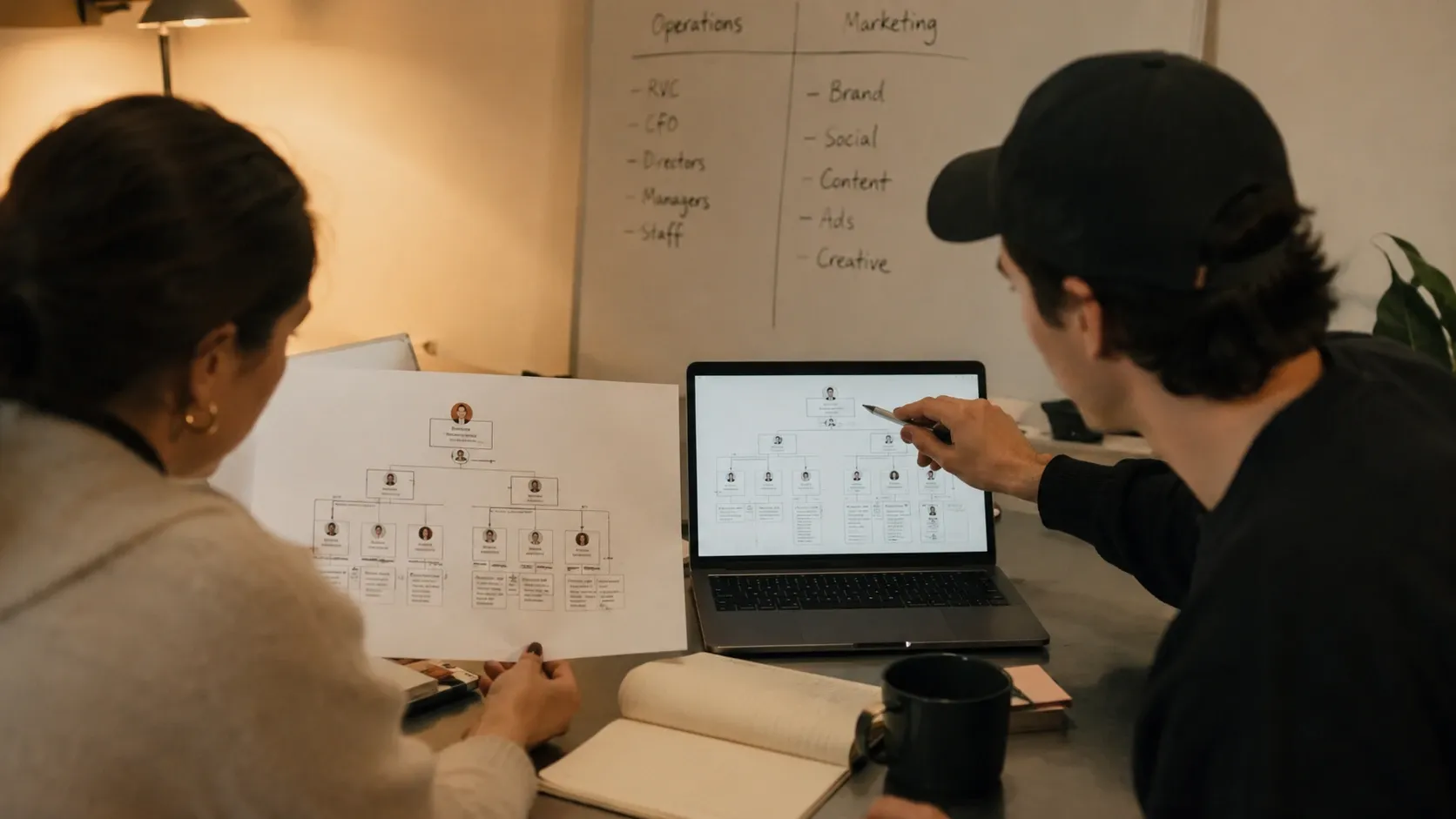
The comparison people actually mean to make
"Agency vs. in-house" usually isn't a fair comparison, because a single in-house hire and a full agency retainer aren't the same scope of work. One person can't shoot content, run paid ads, manage community replies, and build strategy at the same level a small specialized team can — not because they're not capable, but because it's genuinely four different skill sets.
When an agency is the better first move
A single-location restaurant early in its growth typically gets more for the money from an agency: photography and video production, a content strategist, someone running paid ads, and reporting — for roughly what one junior in-house marketing hire costs on salary alone, before benefits.
When in-house starts to make sense
Once a restaurant group is running enough locations that there's genuinely full-time work — coordinating content calendars across locations, managing a growing ad budget, responding to community in real time — an in-house hire (or a small in-house team) can make sense, often paired with an agency for production work that still benefits from a dedicated crew.
The hybrid most groups actually land on
Many multi-location groups end up with an in-house marketing lead who owns strategy and day-to-day management, working alongside an agency for content production and paid media execution — getting the consistency of an in-house point person without needing every specialized skill on payroll.
The actual question to ask
Not "agency or in-house" in the abstract, but: is there enough volume of work right now to justify a full-time salary for each specialized skill, or is it more efficient to buy that expertise as a team? For most restaurants under three locations, the math favors an agency.
Questions people ask
At what point does in-house become cheaper than an agency?
There's no fixed number, but it typically becomes worth evaluating once there's genuinely full-time work across content, strategy, and paid media — often around the point a restaurant group reaches three or more locations, though it depends heavily on scope.
Can a business do both at the same time?
Yes — this is actually the most common setup for growing multi-location groups: an in-house lead owns strategy and day-to-day management, while an agency handles content production and paid media execution.
Newsletter
Liked this? Get the next one first
New writing on getting found in search and AI answers, restaurant marketing, and the work behind our projects. Only when it’s worth your time.
How we can help
Proof
Keep reading
Our seven picks for restaurant influencer partnerships in Tampa Bay and Orlando are Food by Tiana, Tasty Chomps, Jesus Andres Andrade, Bin Min Munch, Michael Haffner, Mr. Tampa Bay and Your Tampa Bestie — chosen for local trust, thoughtful content and how their audiences actually respond, not follower counts.
The Best Social Media Marketing Strategies for Tampa Businesses in 2026Tampa is a visually competitive market, so social media marketing here rewards original footage over stock, short vertical video over static posts, and consistency over volume. What works differs by sector: hospitality and restaurants win on food and room footage, med spas on results and trust, real estate on place, and service businesses on the person doing the work.
What Does a Social Media Marketing Agency Actually Do for a Business?A social media agency does considerably more than post. The work is strategy, original photography and video production, editing for short-form, writing, scheduling, community management, paid advertising, creator outreach, analysis and creative direction. Most of the hours go into producing content, not into publishing it, which is the part clients rarely see.