
What Should Food Cost Percentage Be for a Restaurant?
There is no single correct food cost percentage. The right target depends on your concept, your product mix, your labor model and your price point. A pizzeria and a steakhouse should not aim for the same number. What matters more than the percentage is contribution in dollars, since a high food cost item that sells constantly can be worth more than a cheap one nobody orders.
What is a good food cost percentage for a restaurant?
There is no single correct number. Commonly cited targets sit somewhere between twenty-eight and thirty-five percent, but that range describes an average across wildly different businesses. A pizzeria, a steakhouse, a coffee shop and a sushi restaurant have genuinely different economics, and the right target for each is different. Your correct food cost is the one that lets your concept cover labor, rent and overhead while leaving a profit.
Search for this question and you will be handed a number, usually thirty percent, presented as a law. It is not a law. It is an average, and averaging a steakhouse with a juice bar produces a figure that describes neither.
Why the benchmark misleads
Food cost percentage is a ratio between two things a restaurant chooses. Change either one and the ratio moves, without anything being better or worse.
Consider two restaurants.
The first is a fast-casual concept. Simple food, small team, low rent, high volume. Food cost runs thirty-three percent, labor runs twenty-two percent.
The second is a chef-driven restaurant with detailed plating and a large brigade. Food cost runs twenty-seven percent, labor runs thirty-six percent.
By benchmark logic, the second restaurant is winning on food cost. In practice the first has a prime cost of fifty-five percent and the second is at sixty-three percent. The one with the "worse" food cost is the healthier business.
This is why food cost cannot be judged alone. It only means something next to labor, and together they are prime cost. Prime cost is the number that actually describes whether a restaurant works.
What genuinely moves your correct target
Concept and product mix
Ingredient-heavy concepts carry higher food cost by nature. A steakhouse is buying expensive protein and cannot cook its way out of that. It compensates with price point and check average.
Concepts built on inexpensive base ingredients run lower. Dough, rice, pasta and beans are cheap. Pizza and noodle concepts typically show lower food cost percentages and are not necessarily more profitable for it.
Labor model
Food cost and labor trade against each other constantly, and most operators do not think of it as a trade.
Buy pre-portioned protein and pre-cut vegetables and your food cost rises while your prep labor falls. Break everything down in house and food cost drops while labor climbs.
Neither is right. What matters is where the total lands, and which one your building, your team and your volume can actually support.
Beverage mix
Beverages usually carry far better margins than food. A restaurant with a strong bar can sustain a higher food cost percentage because the beverage side subsidises it.
If you compare your combined number to a benchmark built mostly on food-led operations, you will draw the wrong conclusion. Track food and beverage separately.
Price point and check average
The same plate at eighteen dollars and at twenty-eight dollars has the same cost and two different percentages. Higher check averages tend to produce lower food cost percentages without any operational improvement whatsoever.
Service model
Takeout and delivery add packaging cost that dine-in does not carry, and delivery adds commission on top. A restaurant that shifted heavily toward off-premise sales will see its numbers change even when the kitchen is doing everything exactly the same as before.
The number that matters more: contribution dollars
Percentages tell you about efficiency. Dollars tell you about the bank.
Take two dishes.
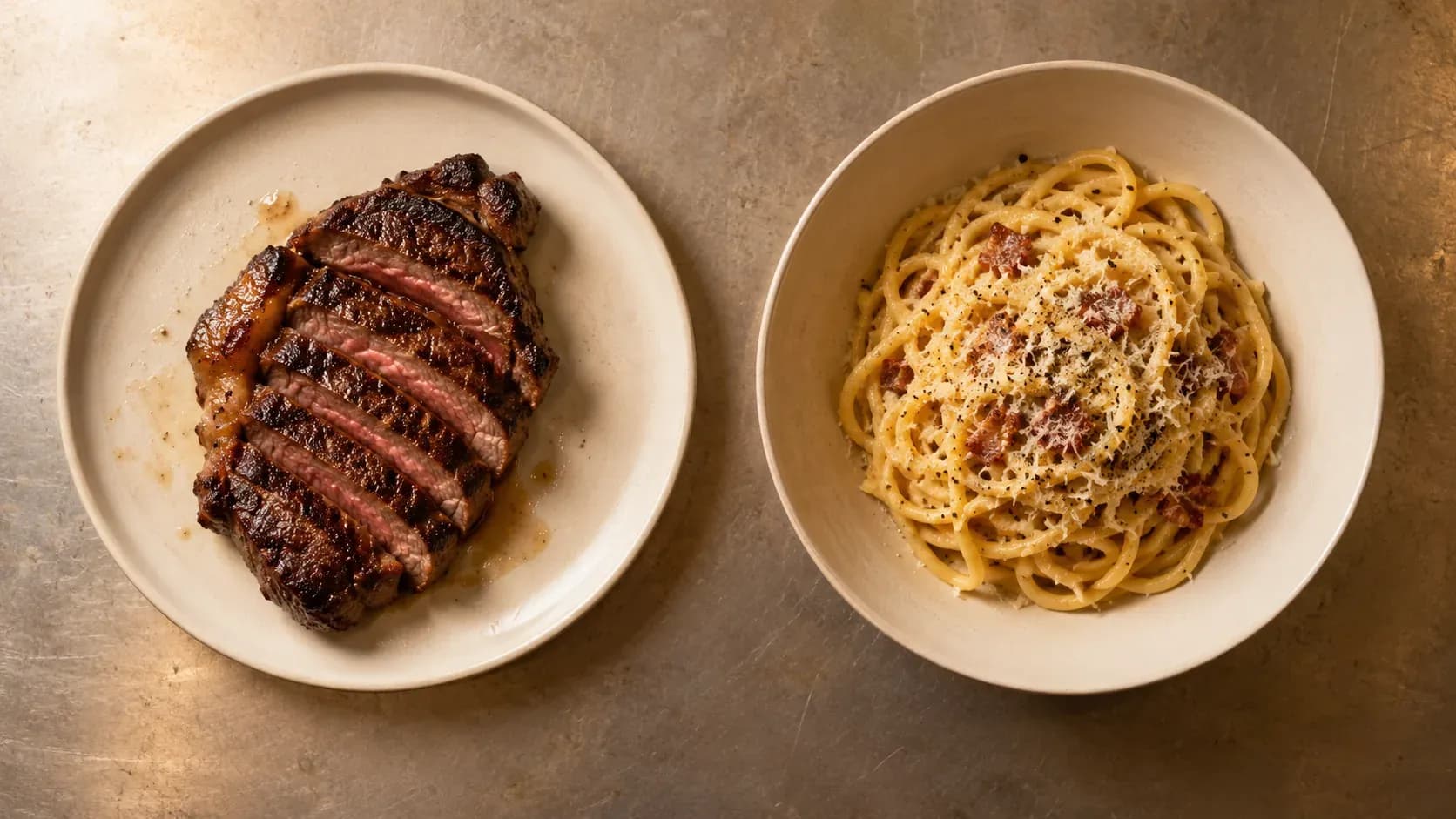
The first is a steak. It sells for thirty-eight dollars and costs fourteen to produce. Food cost is thirty-seven percent, which looks poor. It contributes twenty-four dollars.
The second is a pasta. It sells for nineteen dollars and costs four and a half. Food cost is twenty-four percent, which looks excellent. It contributes fourteen dollars and fifty cents.
The "bad" dish contributes nine dollars and fifty cents more every time it sells.
Rent is not paid in percentages. Payroll is not paid in percentages. Both are paid in dollars, and the steak brings more of them to the table.
This is why menu decisions made on food cost percentage alone go wrong. Cutting a high-percentage item that sells well and contributes strongly can lower your food cost percentage and lower your profit at the same time.
The trap of chasing a lower percentage
You can always lower food cost percentage. The question is what it costs you elsewhere.
Cut portions and the percentage improves while value perception drops and repeat visits fall.
Switch to cheaper ingredients and the percentage improves while the food gets worse, which shows up in reviews before it shows up in sales.
Remove expensive dishes and the percentage improves while your highest-contribution items leave the menu.
Raise prices across the board and the percentage improves while some regulars quietly stop coming.
Each of these makes one number look better. None of them necessarily makes the business better.
How to set your own target
Work backwards from what the business has to cover.
Start with your fixed costs. Rent, insurance, utilities, subscriptions, loan payments, everything that arrives whether or not anyone eats. Add them up per month.
Add your realistic labor cost, based on the schedule your concept actually requires, not the one you wish it required.
Add the profit you need the business to produce. This is a requirement, not a leftover.
Subtract all of that from your realistic monthly sales. What remains is what you can spend on food. Divide it by sales and you have your target.
That number is yours. It accounts for your rent, your team, your volume and your concept. It might be twenty-six percent. It might be thirty-eight. Either way it means something, which is more than can be said for a benchmark pulled from an article.
How to use benchmarks properly
They are not useless. They are just the wrong tool for judging your business.
Use them for direction rather than verdict. If you are running forty-four percent in a concept where similar operators run around thirty, something is likely wrong and it is worth investigating. That is a genuinely useful signal.
Use your own history as the real benchmark. Your food cost last quarter, compared against this quarter, in your building, with your menu, is far more informative than any industry average. Movement is the signal. A number that jumps four points in a month is telling you something changed, and the variance between theoretical and actual cost is how you find out what.
The short version
Stop asking what food cost should be. Ask three questions instead.
What does my concept require, given my labor model, price point and mix?
Which items contribute the most real dollars, regardless of their percentage?
Is my number moving, and if so, why?
Those three will tell you more than any benchmark will.
If you want a target calculated against your actual rent, labor and volume rather than an industry average, that is part of what our restaurant consulting work covers.
Questions people ask
What is the average food cost percentage for a restaurant?
Commonly cited targets fall between twenty-eight and thirty-five percent, but that range averages very different business models. A pizzeria built on inexpensive base ingredients and a steakhouse buying premium protein should not aim for the same figure, and the average describes neither accurately.
Is a lower food cost percentage always better?
No. You can lower the percentage by cutting portions, buying cheaper ingredients, removing expensive dishes or raising prices, and several of those can reduce profit while improving the ratio. Food cost only means something alongside labor cost, which together form prime cost.
What is contribution margin and why does it matter more than food cost percentage?
Contribution margin is the dollars a dish returns after its food cost. A steak selling at thirty-eight dollars with fourteen dollars of cost shows a thirty-seven percent food cost but contributes twenty-four dollars. A pasta at nineteen dollars with four dollars fifty of cost shows twenty-four percent but contributes fourteen dollars fifty. Rent and payroll are paid in dollars, not percentages.
How do I work out the right food cost target for my restaurant?
Work backwards. Add up fixed costs, add the labor your concept genuinely requires, add the profit the business needs to produce, and subtract all of it from realistic monthly sales. What remains is what you can spend on food. Divide by sales for a target built on your rent, team and volume rather than an industry average.
Newsletter
Liked this? Get the next one first
New writing on getting found in search and AI answers, restaurant marketing, and the work behind our projects. Only when it’s worth your time.
How we can help
Keep reading
A busy restaurant can still lose money because revenue and profit are different things. Sales must cover food, labor, rent, card fees, delivery commissions, waste and discounts before anything reaches the owner. When a full dining room produces no profit, the cause is usually prime cost rather than traffic. Start with food cost, labor cost and inventory variance.
How to Increase Restaurant Profit Without Getting More CustomersYou can raise restaurant profit without adding a single guest by making more money from the sales you already have. The levers are recipe costing, portion control, vendor pricing, menu engineering, forecast-based scheduling, waste tracking and comp control. On thin margins, a few points of improvement in food and labor efficiency often moves the bottom line more than a marketing push.
Where Restaurants Quietly Lose Thousands of Dollars Every MonthRestaurants rarely lose money in one large, obvious place. They lose it in small leaks that repeat hundreds of times a month: over-portioning, free add-ons, unrecorded waste, uncaught vendor increases, spoilage, comps, unnecessary overtime, forgotten subscriptions and delivery commissions. A mistake worth forty cents, made four hundred times, is sixteen hundred dollars a month.