
How Much Does a Small Business Website Cost in 2026?
Most professionally built small business websites cost between $2,000 and $12,000, plus roughly $120–$2,400 a year to host and maintain. DIY templates cost far less up front; custom sites with booking, ordering, several languages or system integrations often start around $15,000.
That's the short answer. The longer one is that the price of a website depends almost entirely on what it has to do for your business. This guide explains how to tell which band you're in, what the yearly costs look like, and how to compare quotes without getting burned.
What do published price guides say?
They disagree, and it's worth knowing why: almost every website price guide online is written by a company that sells websites. That includes this one. So here are the bands two 2026 guides converge on, with that caveat attached.
WD Strategies' 2026 guide puts it like this:
- DIY website builder (Wix, Squarespace and similar): $0–$500 up front, then $15–$60 a month.
- Freelancer or small agency: $1,500–$12,000.
- E-commerce or feature-rich site: $3,000–$25,000+.
- Custom or enterprise build: $15,000–$100,000+.
OneLittleWeb's cost study gives a similar picture: $2,000–$8,000 for a typical small business site, $5,000–$25,000 for a mid-sized business, and ongoing costs of roughly 15–30% of the build price each year.
Neither guide is based on a published survey, so treat the numbers as a map of the market, not a price list.
What actually moves the price?
Five things, in roughly this order:
- What the site has to do. A brochure site that says who you are and how to reach you is the cheapest kind. Online booking, ordering, a member area, a product catalogue or a quote calculator each add real build and testing time.
- Custom design or a template. A template is a design someone else made for thousands of businesses. Custom design costs more because someone is designing for yours, and it's usually the difference between looking like everyone else and looking like you.
- Content. Copy, photography and video are often the biggest hidden cost. A beautiful layout filled with stock photos and generic text won't win anyone over. If the agency also writes your pages and shoots your food, rooms or team, the price reflects that, and so does the result.
- Languages and locations. Every extra language or location page multiplies the content and the testing.
- Integrations. Connecting the site to your booking system, POS, CRM or email platform is where custom work earns its keep, and where cheap builds quietly break.
What does a website cost to run each year?
Building the site is only part of the bill. Plan for:
- Domain: about $10–$20 a year for a standard .com.
- Hosting: from a few dollars a month for basic shared hosting to $30–$150+ a month for fast, managed hosting.
- Maintenance: security updates, backups, small content changes and fixes. Some owners do this themselves; most pay for a plan.
- Builder or software subscriptions if you're on a platform like Wix, Squarespace or Shopify, plus any paid plugins or apps.
WD Strategies puts total running costs at roughly $120–$2,400 a year for most small sites. The single biggest variable is whether you pay someone to look after it.
Is a template site good enough?
Sometimes, yes. If you're testing an idea, you need something live this week, or your business genuinely runs on word of mouth, a well-chosen template is a sensible start.
It stops being enough when the website has to win business on its own: when people compare you with three competitors before calling, when you need to rank on Google, or when your brand is the reason people pick you. We go through that trade-off in detail in custom website vs Wix, Squarespace or WordPress.
What does a custom build get you that a template can't?
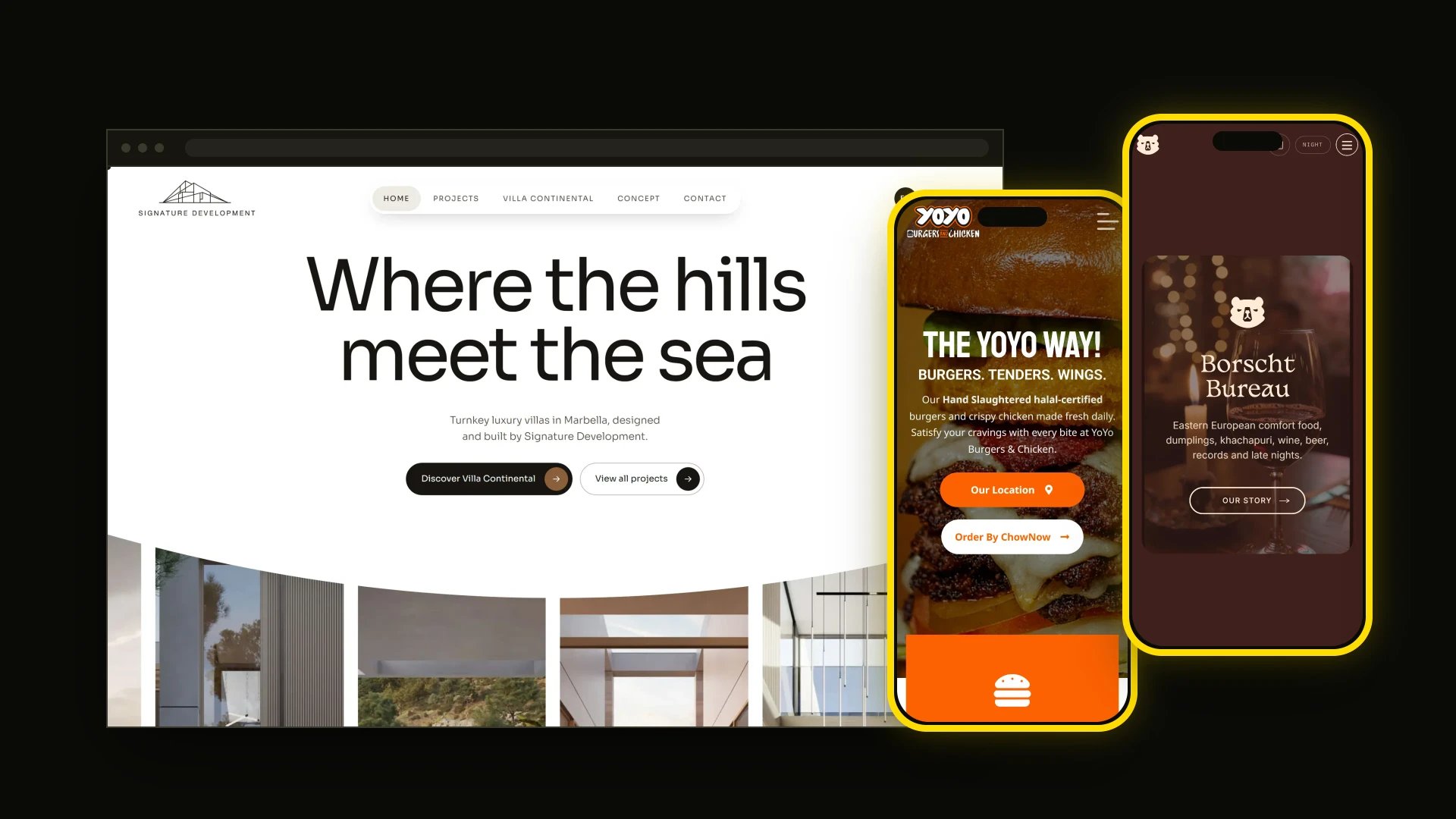
A real example. Signature Development builds luxury villas on Spain's Costa del Sol, and its old site ran on a website-builder template. We rebuilt it as a custom site, in English and Spanish, with things a template simply doesn't offer:
- the villa's 3D walk-through running inside the page, with its own full-screen control
- a day-to-dusk slider on the villa page
- every project driven from one data file with a status (coming soon, in progress, for sale, sold), so adding the next villa is an edit, not a design job
None of that is decoration. Each piece answers a question a buyer has before they get in touch. That's what you're paying for with custom work: a site built around how your customers decide. You can see it running live on our web design page.
How do you compare quotes from different agencies?
Two quotes for "a website" can describe completely different things. Ask each one:
- Who owns the site and the domain when we're done? It should be you.
- Can we edit text, photos and pages ourselves? You shouldn't need a developer to change your opening hours.
- Is the copy, photography or video included, or do we supply it?
- What's included for SEO? At a minimum: page titles, descriptions, headings, structured data, a sitemap, fast loading and a mobile-first build.
- How fast will it load on a phone? Ask for a Google PageSpeed score on a site they've already built.
- What happens after launch? Hosting, updates, fixes and who to call.
What are the red flags?
- A very low price with a long monthly contract you can't leave without losing the site.
- No answer to "who owns it?"
- No mention of SEO, speed or mobile at all.
- A portfolio of sites that all look the same.
How do you know it was worth it?
A website is worth what it brings in: calls, bookings, enquiries and sales. A cheap site that never produces a lead is the expensive option. If yours looks good but stays quiet, we wrote about why in why a beautiful website doesn't generate leads.
As a reference point, this site is built the way we build client sites: custom code, a content system our team edits without a developer, and structured data on every page. In Google's own Lighthouse test it scores 100 for SEO and 98 for desktop performance (October 2026).
Want a real number for your site?
Every price above is a range because every business is different. Tell us what your website needs to do, and we'll come back with a price and a timeline for your project, not a range. Based in Tampa, working with businesses across the US.
Questions people ask
How much does a website cost in Tampa?
Tampa quotes fall in the same bands as the rest of the US. Location matters far less than scope: a professionally built small business site is typically $2,000–$12,000, and a custom site with booking, ordering or integrations often starts around $15,000.
How much does a website cost per month?
Running costs for most small business sites are roughly $10–$200 a month: domain, hosting, and maintenance or software subscriptions. The biggest variable is whether you pay someone to maintain the site for you.
Is Wix or Squarespace good enough for a small business?
For a new business, a test idea or a word-of-mouth business, a well-chosen template is a sensible start. It stops being enough when the site has to win business on its own: ranking on Google, standing out from competitors, or running custom features like bookings or integrations.
How long does it take to build a small business website?
A template site can be live in days. A custom site usually takes a few weeks to a few months, depending on the number of pages, the content that has to be written or shot, and any integrations.
Should SEO be included in the price of a website?
The basics should be: page titles and descriptions, a clear heading structure, structured data, a sitemap, fast loading and a mobile-first build. Ongoing SEO work, like content and local listings, is a separate service.
Newsletter
Liked this? Get the next one first
New writing on getting found in search and AI answers, restaurant marketing, and the work behind our projects. Only when it’s worth your time.
How we can help
Technical SEO, on-page structure, and local search optimization for Tampa-area businesses — the foundation that makes every other marketing channel perform better.
Web DesignCustom Next.js and Payload websites, paired with original in-house photography and video — built to load fast, rank well, and give you full editorial control without touching code.
Proof
Keep reading
Start with the jobs that happen the same way every time and cost you money when they’re slow: replying to new leads, following up, booking and reminders, asking for reviews, and weekly reporting. Instant lead replies come first — they’re the easiest win and the costliest to get wrong.
SEO for Restaurants in Tampa: How to Show Up on Google Maps and in ChatGPTRestaurant SEO in Tampa comes down to four things: a complete Google Business Profile, a steady flow of real reviews, a fast website with your menu as text instead of a PDF, and mentions on the local sites Google and AI tools trust. Get those right before anything else.
Custom Website vs. Wix, Squarespace or WordPress: What Should a Growing Business Choose?There is no single right platform. Squarespace and Wix are genuinely good choices for a small site that rarely changes. WordPress suits content-heavy sites with a maintainer. A custom build earns its cost when the site is a working part of the business rather than a brochure, and when speed, structure or integrations start deciding revenue.